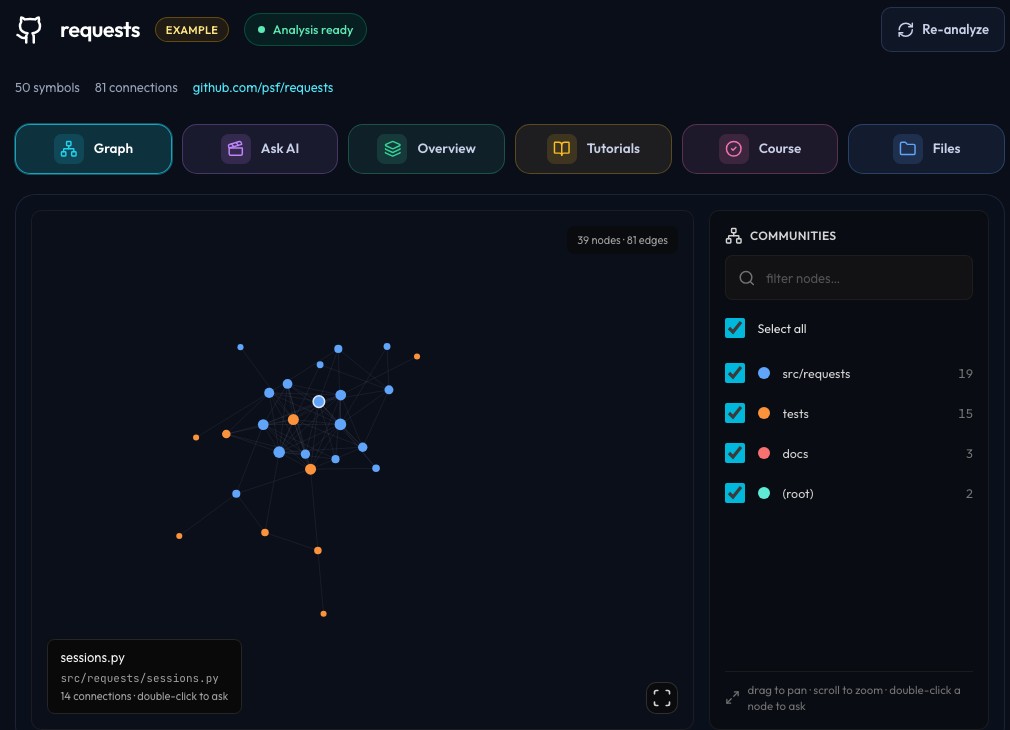
Files, classes and functions as nodes; imports and calls as edges — the parts that matter most surface first.
Flagship · Codebase → course
Turn a GitHub repo into a course.
Built to read a real codebase. CourseSmith analyzes your actual source, answers questions about it with citations, and builds a programming course — real code, real diagrams, real execution traces. Not a talking head. Not stock footage.
A real example
One repo → a full course.
- 1
Paste the repo URL
github.com/psf/requests - 2
Click “Analyze”
CourseSmith clones the repo and reads the real source.
- 3
Explore, then build
Graph, Ask AI, Overview and Tutorials — then Build course.
- 4
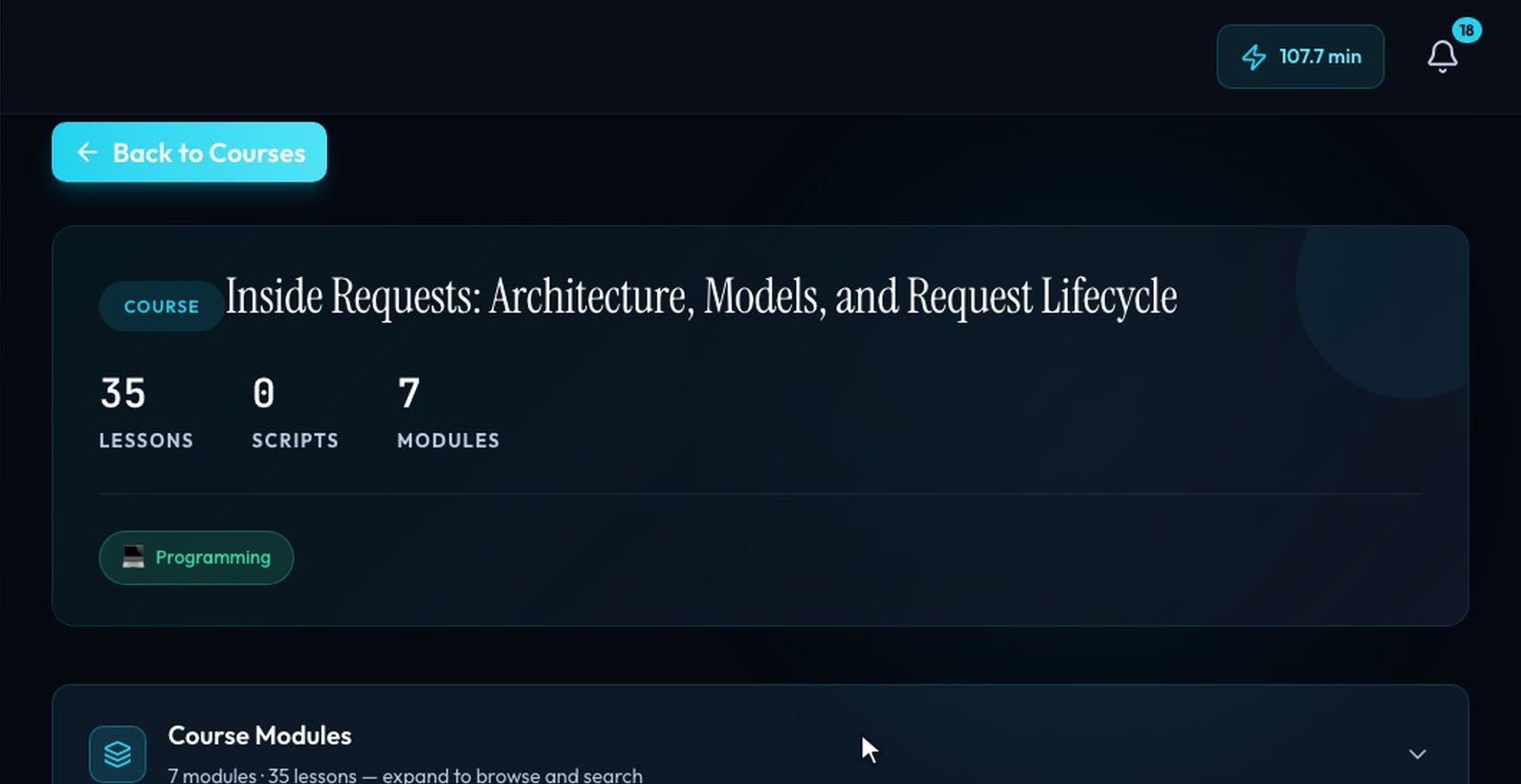
Course generated
7 modules · 35 lessons, each ready for its script.
A video about code should show the code, not just talk about it.
AVATAR TOOLS
A presenter reads a script. The avatar can’t render your function, your class diagram, or your call flow.
STOCK-FOOTAGE TOOLS
A lecture on “Kubernetes” gets a generic server-room clip. Visually busy, pedagogically empty.
COURSESMITH
Reads the repo and renders the actual code and diagrams — deterministically, from your source.
The Codebase workspace
It reads the repo — then answers for it.
Every analysis opens in one workspace with six tabs. The repo is parsed into a real symbol graph; ask it anything and the answer cites the exact lines it came from.
The symbol graph
Files, classes and functions become nodes; imports and calls become edges. Communities are detected and ranked by centrality, so the parts that matter most surface first.
Ask, with citations
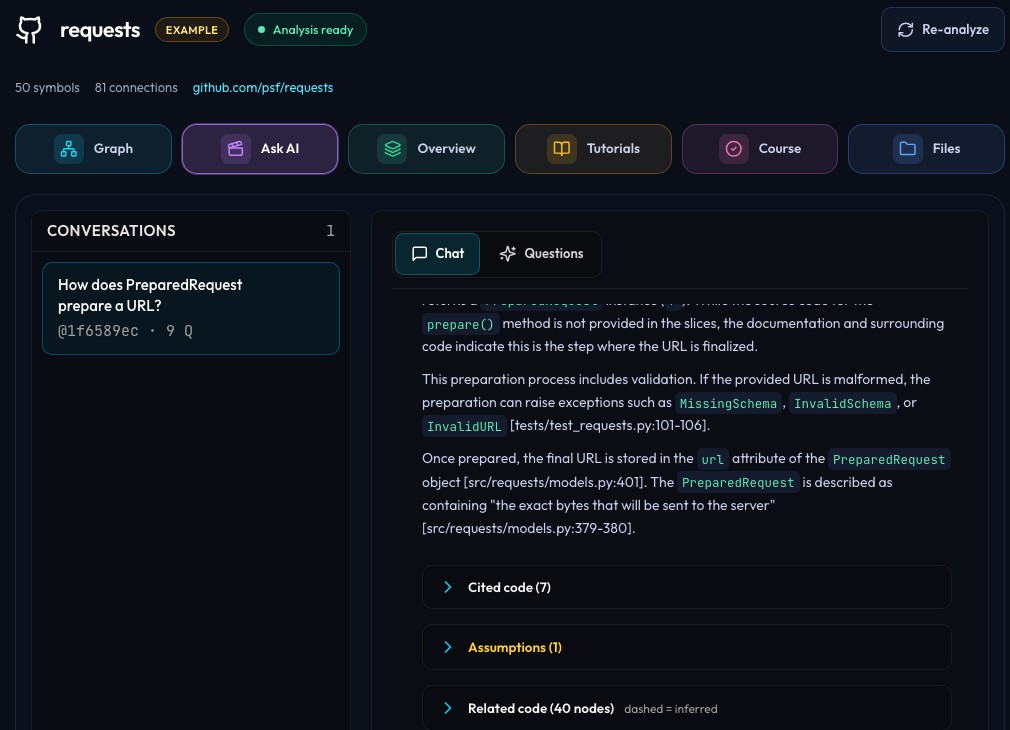
Start from the suggested questions or ask your own. Answers quote the real files and line ranges behind them and flag weakly-grounded claims instead of bluffing.
Suggested questions to start, or your own; answers cite the files and line ranges they came from.
What the repository does, how it is laid out and its key abstractions.
Walkthroughs of the main flows, written from the code.
The course built from the analysis, linked to its lessons in your Projects.
The source itself, to check any answer against.
From one repo
Six things it draws from your source.
Real, syntax-highlighted code
Your actual functions on screen — highlighted, scrollable, never a screenshot or a retyped approximation.
Call flow, drawn from source
Who calls what, in what order — a sequence diagram generated from the code paths themselves.
The shape of your model layer
Classes, fields, and relationships mapped into a diagram a learner can actually follow.
State machines made visible
The states and transitions hiding in your logic, rendered as a clean state diagram.
The system at a glance
Services, modules, and data flow — an architecture diagram that matches the repo, not a stock template.
Execution, step by step
Walk a function’s execution line by line so learners see how the code actually runs.
How it works
Repo in, course out.
Paste a GitHub link
Paste the repository’s link and click Analyze. CourseSmith reads the real source — or open one of the example repositories first.
Explore it
The Graph maps files, classes and calls; Ask AI answers from the code with citations; Overview and Tutorials explain the structure.
Build the course
One click plans the modules and lessons from the analysis, with code slides, diagrams and execution traces drawn from the source.
Shape it and export
Every lesson is narrated, chaptered and editable in the storyboard — export a polished MP4 when it’s ready.
Learn CourseSmith
Watch the short tutorial.
Your repo is already a course. We render it.
Point CourseSmith at a repository and get a chaptered programming course. Studio analyzes one repository a month — re-running it does not count again — and Enterprise has no repository limit.